Your CPA is higher than the industry benchmark.
If you are paying more per conversion than competitors, something in the structure, bidding, or conversion path is broken.
 Certified Google Partner Agency
 We manage Google Ads campaigns for businesses that want more than traffic. We want the right people, at the right moment, with a clear path to conversion. MarchiteQ is a certified Google Partner agency. Every campaign we build is designed to learn, optimise, and scale.

MarchiteQ holds Google Partner status. That means our team meets Google's certification requirements, manages campaign spend above the qualification threshold, and delivers measurable performance results for clients.
Being a Google Partner gives our clients access to beta features, priority support, and the latest campaign tools before they roll out publicly.
Certifications held: Google Ads Search, Google Ads Display, Google Ads Video, Google Ads Shopping, Google Ads Apps, Google Analytics.
We do not take over campaigns and start spending. We understand the business first. Then we build the right foundation.
We start with a full account audit. We look at campaign structure, bidding strategy, conversion tracking, Quality Score, auction insights, wasted spend, and historical performance. If there are structural problems, we find them before we do anything else.
We analyse your market. What are competitors bidding on? Where are the gaps? What does the auction look like for your core keywords? What are the search volumes and the realistic CPCs? This shapes the strategy.
We define the campaign architecture before we build anything. Budget allocation, campaign types, bidding strategy, audience signals, and conversion goals are agreed upfront. We also audit your landing page. The best campaign in the world doesn't survive a page that doesn't convert.
We set up conversion tracking before the first euro is spent. Server-side tracking, Google Tag Manager, GA4 integration, and offline conversion imports where relevant. If the data is wrong, every decision after it is wrong too.
We build campaigns that are structured to perform, not just to look clean. Ad groups, match types, negative keyword strategy, asset sets, and audience layers are all deliberate.
Process
Google Ads campaigns do not perform the same way on day one as they do at month six. We work in three structured phases.
Phase 1
Every new campaign starts in a learning phase. The algorithm needs data before it can optimise. In this phase we focus on generating quality conversion signals, testing messaging, and building the data foundation the algorithm needs to work. We do not rush this phase. Cutting it short costs more later.
Phase 2
Once we know what works, we act on it. We cut what is not converting, increase budgets on what is, refine bidding targets, and tighten audience and keyword focus. This is where cost per acquisition starts to drop.
Phase 3
With a proven structure and a reliable conversion rate, we scale. We introduce additional campaign types, expand reach, and increase volume while protecting efficiency. Scaling without the foundation of phases 1 and 2 is how ad budgets get wasted.
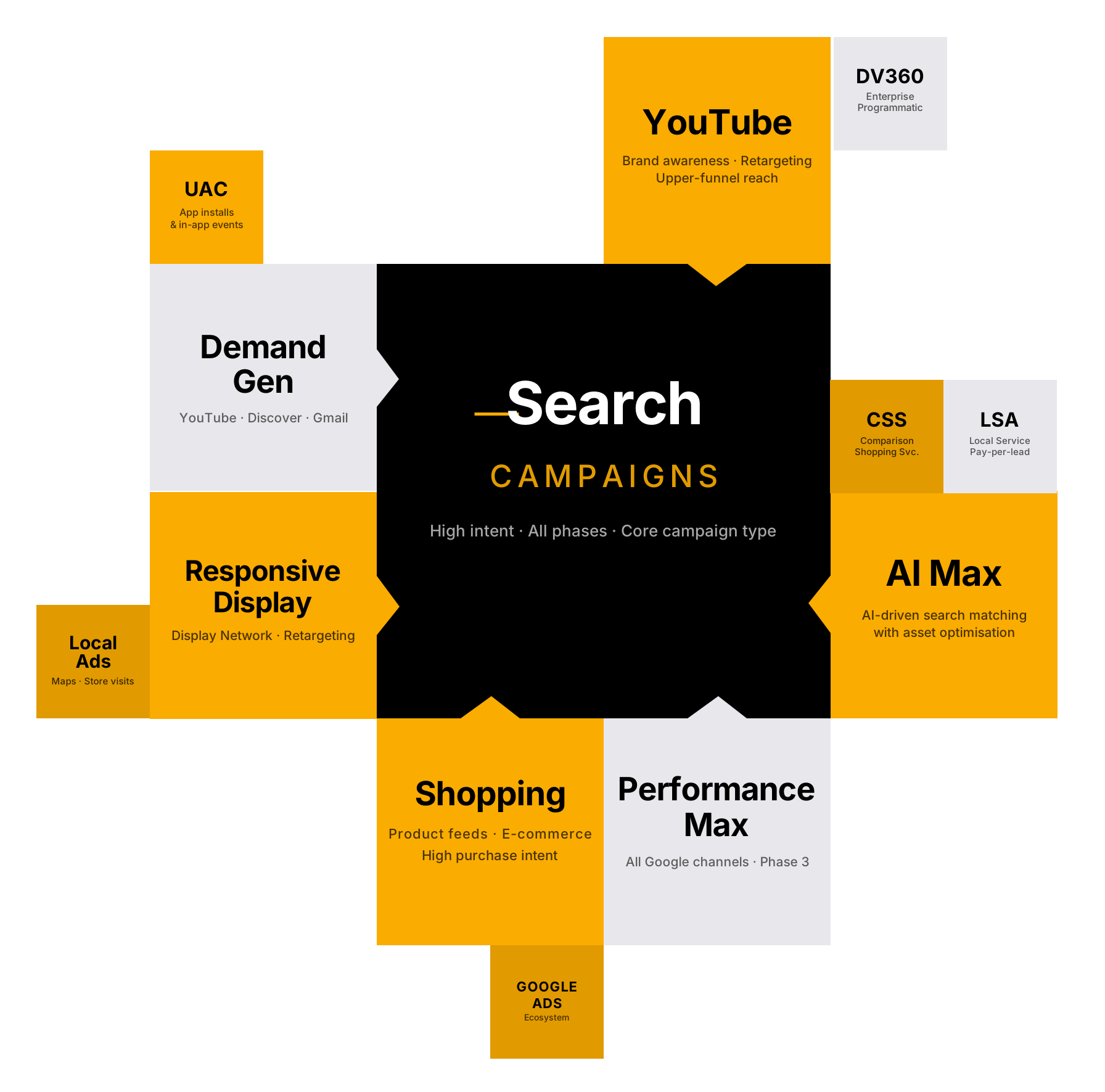
We work across the full Google Ads ecosystem. The right campaign type depends on the goal, the budget, and the phase of the account.
Text ads that appear when users search for your keywords. The most direct campaign type. High intent. Used in all phases.
Product listing ads for e-commerce. Show product image, price, and store name directly in search results. High purchase intent.
Google's fully automated campaign type that runs across all Google channels from a single campaign. PMax needs budget and conversion data to work. It is designed for scaling, not for starting. We use it in phase 3.
Google's newest evolution of search campaigns with AI-driven keyword matching and asset optimisation. Higher automation with more control than PMax. Well suited for accounts with strong conversion data.
Visual campaigns that run on YouTube, Discover, and Gmail. Built for demand creation, not just demand capture. Works well for audiences that do not yet know they need you.
Video ads across YouTube. Used for brand awareness, retargeting, and upper-funnel reach. Strong for building recognition before users enter the purchase decision.
Automated campaigns built specifically for app installs and in-app events. Google optimises delivery across Search, Display, YouTube, and Play.
Image and text ads that run across Google's Display Network. Google assembles the best combination of assets automatically. Used for retargeting and awareness.
Drive store visits, calls, and direction requests. Shown across Search, Maps, Display, and YouTube. For businesses with physical locations.
Pay-per-lead ads for service businesses. Shown above standard search results with a Google Guaranteed or Google Screened badge. High trust signal for local service providers.
An alternative route for Shopping ads that can reduce cost per click by using an independent CSS partner instead of Google Shopping directly. Available in the EU and UK. We operate as a CSS partner.
Enterprise-level programmatic advertising for large accounts. Full control over inventory, audience targeting, and brand-safe placements across the web. For clients with significant display budgets who need more precision than standard Display campaigns allow.
Warning signs
These patterns usually point to structure, bidding, or measurement — not a lack of budget alone.
If you are paying more per conversion than competitors, something in the structure, bidding, or conversion path is broken.
Clicks are coming. Conversions are not. The problem is usually the landing page, the audience targeting, or a mismatch between the ad and what users see after clicking.
Higher CPCs usually signal increased competition, a drop in Quality Score, or a bidding strategy that is working against you.
Unstable ad rank points to Quality Score problems, bidding inconsistency, or poor landing page experience. It is rarely a budget issue.
Quality Score affects CPC and ad rank. A low score means Google does not consider your ad relevant. This is a structural issue, not a budget issue.
Google Ads changes fast. Match types, bidding strategies, campaign types, and best practices from three years ago are outdated. An untouched account is almost always an overspending account.
PMax consolidates everything into one black box. Without supporting campaigns, you have no control over where spend goes and no insight into what is actually working.
Google Ads is not a set-and-forget channel. Auctions shift. Competition changes. Algorithms update. Active management is what keeps performance stable.
If you cannot separate Google Ads performance from organic, direct, or other paid channels, you are making budget decisions based on incomplete data.
Start with your bidding strategy. If you are using a target CPA or target ROAS, the algorithm may not have enough conversion data to bid efficiently, which drives costs up. Check if your conversion rate has dropped — a lower conversion rate means the algorithm bids higher to hit your target. Also review Quality Score: a drop in relevance or landing page experience raises your CPC structurally. Finally, open the auction insights report. If new competitors have entered the auction, that changes the dynamic regardless of what you do.
Ad rank is a product of bid, Quality Score, and expected impact of ad extensions. The highest-leverage move is improving Quality Score, which comes from keyword-to-ad relevance, landing page relevance, and expected click-through rate. Using exact match or tight phrase match keywords in dedicated ad groups usually improves this faster than any bidding change. Increasing your conversion rate — even artificially through micro-conversions like scroll depth or time on site — gives the algorithm better data and can improve delivery. Adjusting your CPA or ROAS target also affects how aggressively the algorithm bids. Sometimes loosening the target temporarily gives the algorithm more room to compete.
No. PMax was designed primarily for e-commerce businesses with product feeds, clear purchase signals, and sufficient conversion volume. It needs more budget than other campaign types to exit the learning phase and more conversion data to optimise effectively. For lead generation businesses, service businesses, or accounts with limited budgets, PMax often consolidates spend in ways you cannot control or measure properly. We treat PMax as a scaling tool, used in phase 3 when the foundation is already proven, not as a starting point.
Ask for an audit of your current account before you sign anything. The quality of that audit tells you most of what you need to know. A good agency finds specific structural problems and explains how they would fix them and why. They do not give you a generic report. If you are new to Google Ads, talk about your goals and be specific about timeframes and budget. Ask them what CPA or ROAS you should realistically expect in the first three months, not after a year. Ask how they structure campaigns in the learning phase and when they start scaling. If they cannot answer those questions clearly, keep looking.
Not automatically. Google's recommendations are designed to increase spend, not necessarily performance. Some are useful. Many are not appropriate for your specific account. Every recommendation should be evaluated against your actual goal. A blanket acceptance of recommendations is one of the fastest ways to lose control of an account.
It depends on your CPC and your target CPA. A general rule: your monthly budget should be at least 10 to 15 times your target CPA to give the algorithm enough data to exit the learning phase. Below that, you are running in permanent learning mode and results will be inconsistent. We always set a budget recommendation based on your specific market and keyword landscape, not a generic number.
The most common causes are: a competitor increasing their presence in your auction, a seasonal shift in search behaviour, a technical issue with conversion tracking, a landing page change that affected conversion rate, or a Google algorithm update. We always check tracking integrity first, because undetected tracking breaks are the most common cause of apparent performance drops that are actually data problems.
The first conversation is free. We look at what you have, tell you honestly what we see, and show you what we would do differently.