Dummy Cookie Banner
Banners that look compliant but are not wired to tags, triggers, or platform APIs.
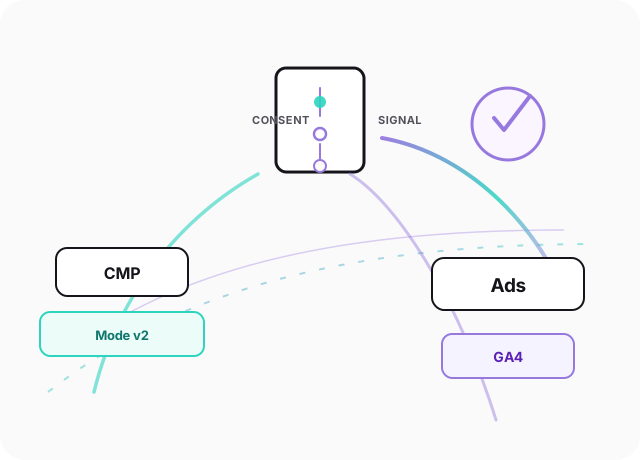
A banner. A popup. “We’ll fix it later”.
If consent is wrong, your marketing engine breaks. Silently.
These are structural failures — not stylistic nitpicking. Left unchecked they starve optimisation and inflate acquisition cost.
Banners that look compliant but are not wired to tags, triggers, or platform APIs.
No Consent Mode v2 (or poorly configured defaults) means data is blocked and learning collapses.
Consent choices never reach Google Ads, Meta CAPI contexts, or GA4 — optimisation flies blind.
Tags stay blocked even after acceptance, or fire before consent — both break trust and reporting.
Conversion tracking slips without anyone noticing dashboards still show “numbers”.
Under-signalled accounts see weaker ROAS, higher CPM/CAC pressure, and slower campaign learning.
MarchiteQ handles what most agencies avoid — the implementation behind the banner: tagging, mappings, defaults, validation, and handover docs.
Google Ads, Meta, and other platforms do not optimise on intentions. They optimise on signals.
If those signals stop at the CMP, your attribution and bidding models degrade — gradually, then steeply.
It is a core skill in modern paid acquisition — bridging legal requirements, CMP behaviour, tagging architecture, and platform policy.
Get it right and budgets compound. Leave it brittle and optimisation plateaus — no matter how strong the creative.
Legal requirements only become performance when paired with disciplined technical execution.
We engineer consent infrastructure end-to-end — not “install plugin, hope for the best”.
Fully mapped cookie banner integrations — triggers, callbacks, renewal logic, geo rules.
Defaults, granular flags, GDPR regions, modeled conversions posture, GA4 Ads links — audited after deploy.
Explicit mapping of CMP states → Google Ads, GA4, GTM/server containers, Meta where applicable.
Tag sequences respect legal categories — no phantom hits, no orphaned pixels, no duplicated consent dialogs.
Events, conversions, Enhanced Conversions and server-side complements aligned to consent granularity.
Zero-party overlays (forms, quizzes, surveys) stitched into attribution where appropriate.
Every implementation ships with validation evidence: test matrices, QA notes, stakeholder readouts, rollback paths.
Restrictions are widening. Passive surveillance does not scale. The shift runs from scraped behaviour to explicit, permissioned choice.
Winners squeeze signal from lawful, minimal inputs — losers chase volume that browsers and regulators choke off.
Counsel drafts obligations. Builders wire reality. Misalignment between mandate and CMP/tag layers is where most programmes fail quietly.
Legal frames the perimeter. Engineering proves it behaves that way under load.
Rapid audits, ruthless transparency, phased implementation — engineered for stakeholder sign-off.
CMP review, consent defaults, vendor inventory, Ads/GA4/Meta linkage, server-side overlays, leakage notes.
Consent blind spots mapped to KPI impact — where algorithms starve vs where lawful lift exists.
Consent Mode rollout, tagging refactors, container hygiene, phased cutovers with guarded monitoring.
Live browser QA, staged user journeys, CMP regression tests — documented for legal + marketing owners.
Runbooks, SOPs for future vendor adds, escalation paths — or embedded retainer when velocity demands it.
Yes — for Google marketing surfaces, advertisers need Consent Mode v2 compliant implementations to adhere to EU user consent policies while preserving permissible measurement features that rely on consented modelling paths.
Most CMPs ship as generic shells. Someone must bind purposes to tag triggers and platform APIs. Until that mapping exists, banners can look credible while tagging remains blind.
Absolutely. Incorrect defaults (“denied” everywhere), stalled callbacks, race conditions before GTM bootstrap, or category mismatches can suppress GA4, Google Ads tags, Meta, and hybrid server-side relays alike.
Directly and measurably. Loss of modeled conversions or blocked tags shrinks optimisation surfaces. Algorithms still spend — they simply learn slower and less accurately, stressing CPMs and CAC.
Zero-party data is what users knowingly supply — intents, preference centres, questionnaires. Combined with lawful consent envelopes, it backfills signal quality as deterministic IDs erode.
Yes — we specialise in bridging counsel-approved policies with deployable tagging systems, leaving legal narrative untouched while guaranteeing technical fidelity.
Your ads, dashboards, and risk profile only stay aligned when consent infrastructure is engineered — not improvised.